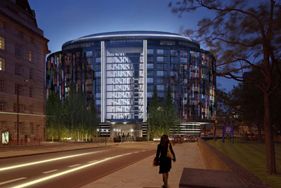
The final beam of the £350 million Park Plaza Westminster Bridge hotel was bolted into place by Mayor Boris Johnson at a "topping out" ceremony last week.
The 1,021-room riverside, dramatic glass-clad heart-shaped building, which offers uninterrupted views of the Houses of Parliament will be one of the greenest in the capital once it opens early next year.
Park Plaza Westminster Bridge London will be London’s biggest ever hotel in a generation, boasting 1,021 guest rooms in at the southern end of Westminster Bridge and it’s to endeavour to be ‘SuperGreen’.
Park Plaza Hotels say that sustainable environmental practices reflect the expectations and desires of its guests, employees, stakeholders and partners in business. Throughout its nearly 40 hotels in the UK, Europe, Middle East and Africa, the company is committed to finding and implementing ways to mitigate its environmental impact through its TREE (Total Responsibility for Everyone’s Environment) and SEASON (Save Energy and Switch Off Now) initiatives. These focus on responsible water and energy usage and waste management.
Several innovative energy- and water-saving efforts already are underway at Park Plaza Westminster Bridge London, which is set to open in early 2010. These include:
ENERGY – The hotel has initiated a tri-generation energy management scheme that will help to significantly reduce the amount of energy it draws from the electrical grid. The components of the energy reduction effort include the installation of a BioMass Boiler that uses wood pellets to generate heat that is used to provide guest room heating and heat water. The wood pellets are generated sustainably from managed forests and produce power that is carbon neutral. In addition, the hotel will generate electricity through its Combined Heat and Power (CHP) Unit. As the hotel’s lead power generator, the CHP uses natural gas to produce electricity and as a bi-product produces hot water for the hotel. For the hotel’s 1,200 square metre Westminster Ballroom, the CHP is expected to reduce the amount of energy drawn from the electrical grid by half. That hot water produced by the CHP also will be used by the hotel’s absorption chiller, the third component of the system. The absorption chiller system absorbs the hot water produced by the CHP Unit and chills it to produce cold water used in the hotel’s air conditioning system, significantly reducing the amount of cooling required by traditional coolers.
INFRA RED TECHNOLOGY – Once more likely to feature in James Bond films than hotel guest rooms, infrared technology has now found its way into Park Plaza Westminster Bridge London. One of the most unique of the hotel’s energy saving efforts is the installation of passive infrared movement sensors (PIRS) in all staff areas, all guest rooms, all public toilets and in fire escapes. Indiscernible to the guest, the highly sophisticated sensors are designed to switch off power when there is no movement in the area to keep energy usage to a minimum whenever possible. In guest rooms, logic circuitry tied to magnetic door switches detects when a guest is not present in the room to switch of cooling and lighting. When a guest is in the room, the system remains switched on. In hotel meeting rooms, staff areas and public toilets, ceiling- mounted infrared sensors detect movement to switch on lighting only when needed. In addition, all projector lamps in meeting rooms are fitted with sensors and switch off when not in use.
REFRIGERATION – At home, we all know its best to keep the fridge door shut to save energy. At Park Plaza Westminster Bridge London, the kitchen and bar fridges (more than 120 in total) will be fitted with new technology to save energy even with the constant use of the refrigerators. With traditional thermostats, when a refrigerator door opens, the thermostat senses a change in temperature and switches on the compressor for additional cooling. New technology called E-Cubes provides a more accurate temperature reading and determines when additional chilling is actually needed to retain the right temperature which reduces the compressor’s load and saves energy.
WATER (Drinking) – In one of its most innovative initiatives, Park Plaza Westminster Bridge London will in one fell swoop significantly reduce carbon emissions with its own on-site water bottling plant. Expected to produce more than one million bottles of (purified, triple-filtered) drinking water each year, the hotel’s water bottling plant will save on the transportation of lorry deliveries of water and drastically reduce the amount of disposable water bottles on site. The water will be bottled in reusable glass bottles for use throughout the hotel from the guest rooms to restaurants to meeting rooms.
LIGHTING – Many people raise their eyes to the ceiling when considering a new idea, which is exactly where they’ll find one of the brightest energy saving measures at Park Plaza Westminster Bridge London – its energy-efficient lighting. An estimated 25 thousand energy-saving LED light bulbs will be used to light tens of thousands of metres of space. LEDs provide many advantages over traditional incandescent light bulbs including lower energy consumption and a longer lifetime. In addition to using LEDs in many public areas, the hotel will use even more efficient compact fluorescent bulbs (CFLs) behind the scenes. By using these energy saving bulbs, the hotel will reduce carbon dioxide emissions by an estimated 606 tonnes per year.
TRIPLE GLAZING – Stunning views to Big Ben, the Houses of Parliament and to the City of London require glass – and lots of it. To offer the best views in the city while being energy-minded, Park Plaza Westminster Bridge London has installed triple-glazed windows. As the name would suggest, rather than just two panes of glass, a third is introduced to further the window’s ability to insulate in winter and reduce heat in summer.
GREY WATER – High above the lush planting that will line the pedestrian paths of Park Plaza Westminster Bridge London, recycling is underway. As part of a grey water scheme, the hotel collects and diverts rainwater from the roof to storage tanks. From there, the water will be used to grow plants in and around the hotel.
Valere Tjolle