Announced in early 2025 by French president Emmanuel Macron, it is finally French Culture minister Catherine Pégard that announced a few days ago the winning team of the architecture competition for the “Louvre Nouvelle Renaissance” project.
Announced at that time by the President of France in the presence of the Minister of Culture and the Mayor of Paris, nearly 40 years after the landmark Grand Louvre project and Ieoh Ming Pei’s iconic glass pyramid, the initiative addresses the urgent need to renovate and modernize the museum.
The plan is designed to preserve the Louvre’s architectural heritage, improve the protection and presentation of its collections, and adapt the museum to evolving visitor expectations, while also meeting long-term sustainability goals. It will also address the safety of collections following last year spectacular robbery.
As part of this extensive modernization program, the “Grande Colonnade” project represents a significant milestone.
Highlighting the Grande Colonnade
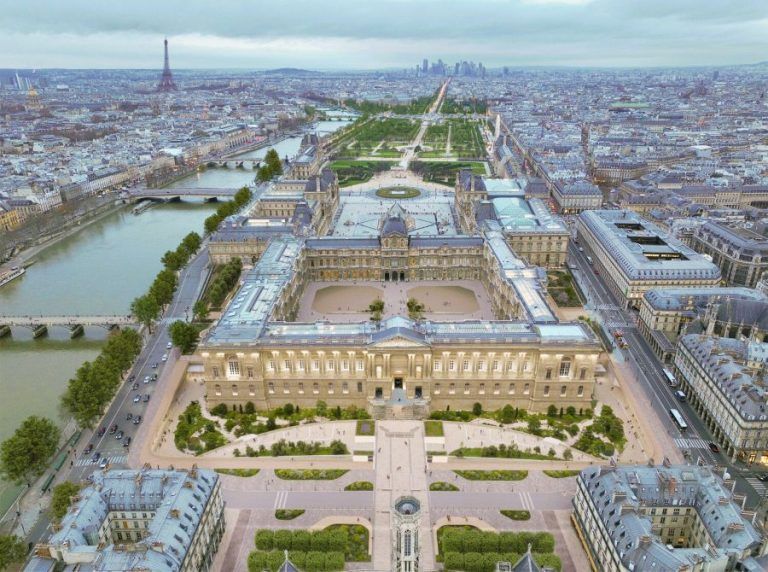
The future structure will highlight the Louvre’s historic Colonnade, a masterpiece of 17th-century French classical architecture created during the reign of Louis XIV, while reconnecting the museum with the city and improving accessibility for all visitors.
The “Grand Louvre” project of the 1980s and 1990s did not fully integrate the former royal palace in its entirety as the redevelopment concentrated in the court around the pyramid.
New entrances and visitor flows from the eastern side of the palace, together with redesigned public spaces, aim to enhance visitor comfort and working conditions for staff at the world’s most visited museum.
On May 13, the jury selected the proposal submitted by STUDIOS Architecture Paris and Selldorf Architects for its architectural quality and its successful integration into the Louvre’s historic, urban and landscaped environment. The jury also praised the project’s visitor-focused design, clear circulation plans, environmental sensitivity, landscaping and thoughtful approach to security.
The winning team combines the expertise of STUDIOS Architecture Paris and New York-based Selldorf Architects. STUDIOS Architecture Paris is part of the international STUDIOS collective. The firm is known for major cultural projects including the Fondation Louis Vuitton in Paris and the Fondation LUMA in Arles, developed alongside Gehry Partners.
Selldorf Architects has earned global recognition for cultural renovation projects such as The Frick Collection in New York and the Sainsbury Wing redevelopment at London’s National Gallery. The firm will also oversee exhibition design and museum scenography for the Louvre project, while BASE Landscape Architecture will lead landscape and urban planning elements.
Former moats to be transformed into gardens and welcome spaces
The selected proposal offers a contemporary yet respectful vision for the Louvre’s eastern entrance through the Colonnade. The design creates an elegant connection between the city, palace and museum.
The project creates a calmer, greener public space extending from Saint-Germain-l’Auxerrois church across the Louvre to the museum’s esplanade. A new belvedere overlooking the transformed and landscaped moats will provide panoramic views of the museum’s façade and offer a cooling green oasis in the heart of Paris.
Visitors will access the moat level via two gently sloping symmetrical ramps integrated into the historic stone walls. New restaurant and bookstore spaces will also be created beneath the ramps and along the moat walls, accessible to all visitors.
Two new underground museum entrances on the Seine and Rue de Rivoli sides will connect visitors to redesigned reception areas, new exhibition galleries. To avoid overcrowding like today, a dedicated visitor route for viewing the Mona Lisa, all seamlessly linked to the rest of the museum.
Catherine Pégard described the appointment of the winning consortium as a “foundational step” in the Louvre’s transformation. In the coming months, the Louvre and the selected team will work together to refine the project. Consultations will involve museum staff, the City of Paris, heritage and security authorities, and the public.
Key elements of the “Grande Colonnade” program will help welcome up to 14 million visitors a year. The museum currently welcomes 9 million visitors a year, twice as much as the maximum capacity conceived 40 years ago by Ieoh Ming Pei with its glass pyramid.