Ryanair has identified seven European airports where passengers are facing the longest delays following the introduction of the European Union’s new Entry/Exit System (EES), saying some border control points remain unprepared for peak summer traffic.
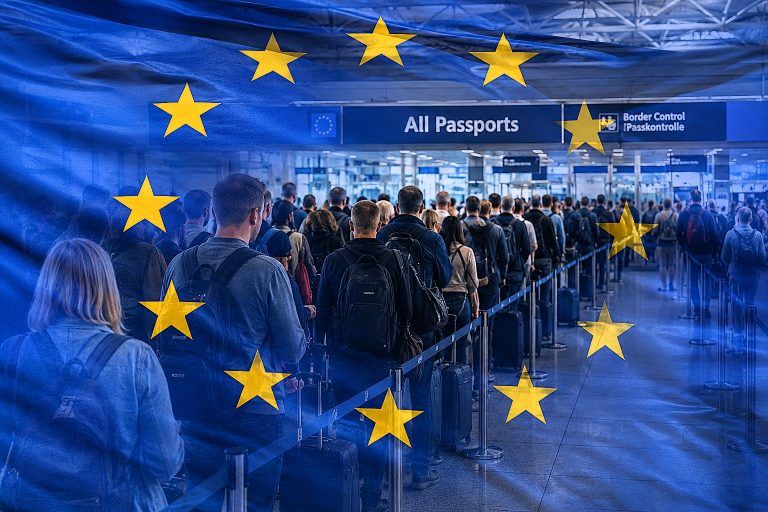
The low-cost carrier said shortages of border staff, biometric kiosks and technical readiness are creating lengthy passport queues for travelers crossing between Schengen and non-Schengen countries.
The EES, fully introduced across the Schengen Area in April, requires non-EU nationals, including UK and US travelers, to register fingerprints and a facial image when entering participating countries. While designed to replace manual passport stamping with a more secure digital system, the rollout has generated longer processing times at several major leisure gateways.
According to Ryanair, the airports currently experiencing the greatest disruption are:
-
Tenerife South, Spain
-
Palma de Mallorca, Spain
-
Alicante, Spain
-
Malaga, Spain
-
Milan Bergamo, Italy
-
Krakow, Poland
-
Paris Beauvais, France
The airline said some passengers have already missed flights because of extended border control waits and is advising customers traveling between Schengen and non-Schengen destinations to arrive at the airport well ahead of their scheduled departure time.
Ryanair has also renewed its call for European governments to postpone further expansion of the EES until after the busy summer season, arguing that airports need additional time to recruit staff, install more biometric kiosks and optimize border procedures.
EU Commission President von der Leyen acknowledges “technical problems”
The European Commission has in-between acknowledged that the implementation of the new system has presented operational challenges at some airports. At a press conference in Cork, Ireland, European Commission President Ursula von der Leyen recognized that the digital Entry/Exit System is experiencing “technical problems.”
“We are working with the member states [so] that the technical problems are being solved,” von der Leyen told to her audience.
She however stressed that the Entry/Exit System is a cornerstone of the EU’s modern border management strategy. She has recognized that adjustments are needed during the rollout but maintains that the biometric system ultimately strengthens the protection of the EU’s external borders, improve security, and help combat irregular migration and cross-border crime while facilitating more efficient border crossings once fully operational. Some 1,000 people have already been refused access to the EU since the EES rollout last April.