Florida´s Space Coast is all set for the sea turtle season.
Every year from March to October Leatherbacks, Loggerheads, Green Sea Turtles and sometimes Kemps Ridley turtles return to the beaches to lay their eggs.
In 2023 more than 52,000 sea turtle nests were counted on the beaches of Florida´s Space Coast.
From the northernmost point of the Canaveral National Seashore to the Beaches of the Sebastian Inlet in the South, visitors and residents must be on alert to protect turtles and their nests.
Depending on the species these nests will be up against the dunes or right in the middle of the beach.
Organisations such as the Sea Turtle Preservation Society mark these nests with wooden stakes, so visitors are aware and do not disturb them. When the turtles leave the nests, they make distinctive tracks leading to the ocean which vary by turtle species; these can be best seen at sunrise before the tide and the winds erase them.
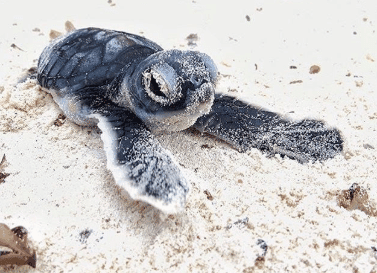
As the season progresses, the chances of spotting the hatchlings increases as incubation varies from 45 – 75 days depending on species.
Normally the hatchlings emerge in the dark and use the moon´s reflection on the waves to guide them to the ocean.
The Space Coast is fortunate to offer nesting grounds to four types of sea turtles.
The Loggerhead is the largest of the hard-shell turtles and is named for its massive head and strong jaws. Its shell is heart-shaped with a reddish-brown colour. It is also the most common turtle in Florida.
The Green Turtle has a wide, smooth shell and is named “green” because of its body fat, not its shell, which is browner in colour. Green turtles have a non-retractable head that are relatively small in comparison to its large shell and can weigh over 300 kilos.
The Leatherback is the largest of all sea turtles at up to seven feet long and weighing over 450 kilos. Leatherbacks embark on the longest migration distances between breeding and feeding at around 3,700 miles each way.
Sometimes the region is graced with the Kemps Ridley Turtle; these are some of the smallest of the sea turtles only reaching up to 2 feet and no more than 45 kilos. Its shell is hard and greenish-grey while its belly is off-white or yellow. The Green, Leatherback, and Kemps Ridley Turtles are all considered endangered species.
A safe way for visitors to witness this phenomenon is to participate in a Sea Turtle walk, these are offered at the Archie Carr National Wildlife Refuge, Merritt Island National Wildlife Refuge, the Canaveral National Seashore and some of the beaches in between.
The Archie Carr National Wildlife Refuge in Melbourne Beach is considered by biologists to be the most important nesting area for Loggerhead sea turtles in the western hemisphere and the second most important nesting beach in the world.