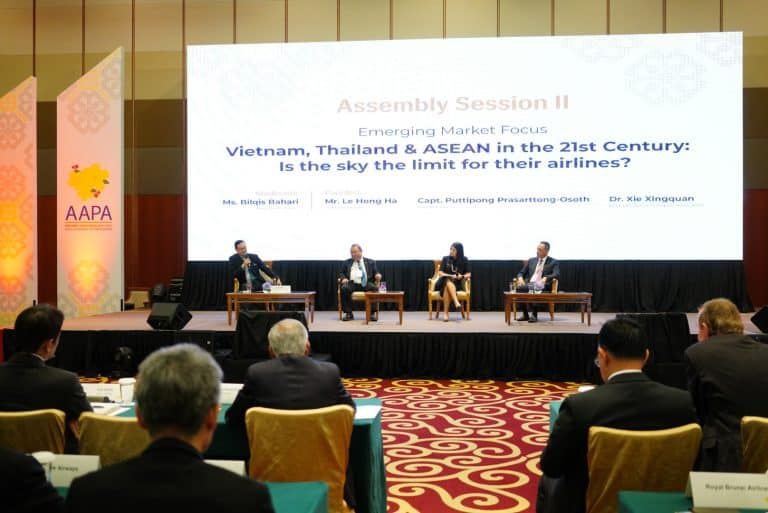
Leaders of the Association of Asia Pacific Airlines (AAPA), gathered for the 68th Assembly of Presidents in Brunei, to discuss the future of aviation.
Under the theme “Jetting into 2050: Future Proofing Asian Aviation,” airline executives were optimistic, as regional air travel continues to surpass the global industry’s growth, while load factors remain steadfastly strong.
The Assembly of Presidents passed a series of resolutions covering sustainability, aviation safety and the streamlining of regulations.
With extreme weather events on the rise, airline leaders noted the risks to aviation safety from climate change.
With Sustainable Aviation Fuel (SAF) in short supply, AAPA believes that a multi-prong strategy in line with the ICAO net zero emissions reduction roadmap, is critical.
The Assembly passed a resolution calling on governments, suppliers, air navigation service providers and airlines to deploy all aspects of the ICAO roadmap.
These include SAF, CORSIA offsets and operational efficiency, to meet the net zero emissions by 2050 goal.
“Every new generation of aircraft and engine delivers 15-20% more fuel efficiency. The acceleration of plans for carbon-friendly aircraft and propulsion systems is an effective pathway to the common goal of net zero carbon emissions,” said Mr. Subhas Menon, AAPA Director General.
Aviation safety remains the number one priority as the Assembly adopted a resolution calling for civil aviation authorities, aviation safety agencies and airlines to work closely together to share best practices through data analysis.
“The Assembly welcomed the results and recommendations of the safety culture survey conducted by the Flight Safety Foundation, as aviation safety is about promoting a proactive safety culture,” Menon added.
The Assembly of Presidents also acknowledged that supply chain disruptions and air space closures, are leading to more flight diversions, delays, and cancellations.
Conflicts such as the Russia-Ukraine war and in the Middle East have resulted in airspace closures, exacerbating the situation.
It called out governments that ‘target only the symptoms of failure, while burdening airlines with more cost and complexity.’
A third resolution was passed calling on governments to refrain from introducing unilateral measures that would disproportionately inconvenience the travelling public and increase the cost burden on the airline industry.
Menon concluded, “The outlook for the region’s airlines is broadly positive, given the sustained demand for air travel. It is a remarkable recovery on key metrics, considering that air transport ground to an almost complete standstill for two years.”