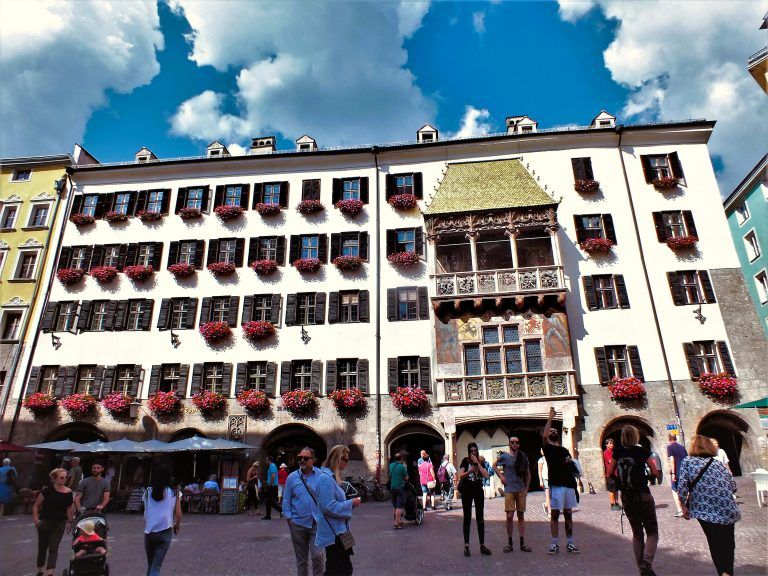
While there is much talk this summer season about anti-tourist movements, particularly in Southern Europe, there is at least one country where tourists will feel welcome. And this is Austria.
Austria’s tourism sector enjoys strong public support, according to the first-ever nationwide survey conducted by Statistik Austria. Based on a representative sample of 14,000 respondents, the findings reveal that 45% of Austrians hold a positive view of tourism, while only a small fraction (7%) express criticism. 47% were neutral or had no opinion (don’t know).
“Almost half of the population views tourism positively. That’s a powerful signal—for the industry, for the regions, and for tourism policy,” said State Secretary for Tourism Elisabeth Zehetner. She emphasized, however, that such trust must be continuously earned: “Tourism acceptance isn’t a given—it must be worked for every day, by businesses, regions, and policymakers alike.”
Regional Disparities in Tourism Perception
A comparison of tourism acceptance across Austria’s federal provinces shows different regional views.
In Vienna (+48 points), Carinthia (+43), Styria (+41), Salzburg (+40), and Vorarlberg (+39), support for tourism was especially high. In Burgenland (+38), it matched the national average. This means people in these regions generally see tourism more positively than the Austrian average.
In contrast, people in Upper Austria (+32), Lower Austria (+30), and Tyrol (+36) were more skeptical. These regions also had more people who felt neutral or had no opinion about tourism’s impact.
73% Recognize Tourism’s Societal Importance
Roughly three-quarters of Austrians (73%) view tourism as vital to various aspects of society and the economy. The survey found a clear link between personal dependence on tourism—either professionally or financially—and a stronger appreciation for its local relevance. In 2024, 5% of respondents said tourism was “very important” to their personal situation, and another 7% considered it “important.”
“When people recognize the relevance of tourism, they are more likely to accept and support it,” said Zehetner. “This confirms our political approach: to embed tourism more deeply into regional development—economically, socially, and in terms of infrastructure.”
Majority Finds Tourism Volume Appropriate
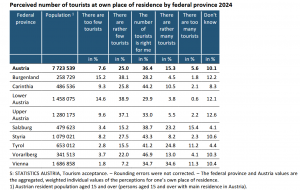
A key indicator of acceptance is how people perceive the number of tourists. Nationwide, 65% considered the number of visitors in their local area and across Austria to be “just right.” Fifteen percent said the number of tourists is “somewhat high,” and only six percent believed it is “too high.”
They are however variations by regions. In Salzburg, 38.6% of locals found that “there are rather many tourists” or “there are too many tourists”. In Tyrol, the proportion of locals feeling overwhelmed by the number of tourists reached 36% and in Vienna 45.9% – an absolute record!
“Plan T” Gets an Update
The findings will feed directly into the renewal of Austria’s national tourism strategy, known as “Plan T.” Originally launched in 2019, the plan is now being updated to reflect modern challenges such as artificial intelligence and energy efficiency.
“Plan T was a milestone—but it’s outdated. The world has changed, and so have the demands placed on tourism. That’s why we need a fresh start,” said Zehetner. Shortly after taking office, she initiated the overhaul, which now enters a broad participation phase.
“Tourism touches everyone’s life in some way—whether through work, hospitality, or public infrastructure supported by tourism revenues. That’s why we want everyone to have a say in shaping the new Plan T,” she added.
Asking the Big Question about Holidays in Austria
The goal is to gather diverse perspectives to create a forward-looking, inclusive tourism strategy. The tourism acceptance survey provides a solid foundation for this process. “We’re asking the big question: How do people in Austria experience tourism? What role does it play in their daily lives, in their work, in their communities—and what do they hope for in the future?” Zehetner explained.
All are invited to participate, whether as hosts, travelers, or residents of tourism-heavy regions. Topics include travel habits, tourism’s impact on quality of life, local development, and current challenges. Click here to participate to the survey.
“Our objective is clear: to shape the tourism of tomorrow—sustainably, inclusively, and with joy. Because only when everyone benefits can tourism remain a long-term success story,” Zehetner concluded.