When Skift reported this week that Kayak co-founders Steve Hafner and Paul English are reuniting at Booking Holdings to build a stealth AI startup called Lola, most of the coverage framed it as a homecoming story. Two metasearch pioneers, back together, with a fresh AI brief.
That reading misses the bigger signal. The reunion is not the news. The news is that Booking Holdings is building Lola at all, because it amounts to the world’s largest online travel company quietly conceding that metasearch, the category Hafner and English helped invent, no longer has a viable future as a standalone proposition.
For anyone selling travel through distribution partners today, that concession matters more than the splash page itself.
The financial subtext
The Lola scoop did not arrive in isolation. In October 2025, Booking Holdings took a $457million write down on Kayak, attributing the impairment to changes in Google’s search practices, the rise of AI Overviews, and a structural shift from organic links to paid listings. In February 2026, Hafner stepped down as Kayak CEO after twenty-two years, taking on a new “AI innovation” role at the parent company. At the time, Booking provided no further detail.
Lola is the detail.
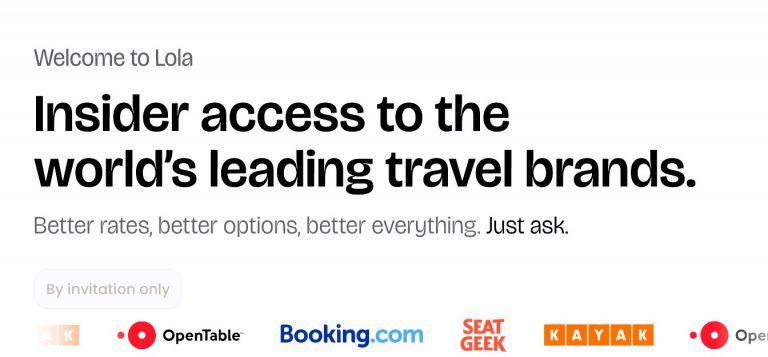
The product itself remains in stealth. The Lola.com and Lola.ai domains, repurchased from English in early April, currently host a single splash page: “Welcome to Lola. Insider access to the world’s leading travel brands. Better rates, better options, better everything. Just ask.”
That last phrase, “just ask”, is doing the strategic work. It signals a conversational, agentic interface where the user expresses an intent rather than navigating filters, sliders and comparison tables. It is, in other words, the architectural opposite of Kayak.
Why Booking is competing with itself
The most striking thing about Lola is where it is not. It is not inside Booking.com, the largest distribution machine in travel. It is not bolted onto Kayak, whose co-founder is now leading the project. It is a separately branded, separately staffed startup with its own URLs.
Companies do not spin up parallel ventures of this kind when they believe the answer is a chatbot inside an existing brand. They do it when they suspect the next interface is structurally different from the last one, to the point that their incumbent assets become a liability rather than a moat.
For the wider trade, this is the signal worth reading carefully. Booking Holdings, which has spent the past decade aggregating distribution power, is now placing a bet that the storefront layer for travel is about to change shape entirely.
Implications for distribution
Three implications follow for suppliers and intermediaries alike.
First, ranking is being replaced by recommendation. The Lola tagline mentions “insider access” and “better rates.” Industry watchers have already noted that SeatGeek appears as a partner alongside Booking-owned brands. The model in miniature is a curated graph of inventory the assistant has been pre-trained to prefer. If a property or service is not in that graph, it is not in the answer.
Second, content discipline becomes a distribution asset. Conversational interfaces reward distinctness, structured data, narrative clarity and the kind of metadata a large language model can ingest cleanly. Hotels, tour operators and DMCs that have invested in clean property data, rich descriptive content and verifiable inventory feeds will find themselves better positioned than those who optimized for a search results page.
Third, partnership terms will start to matter more than ad spend. Metasearch was a CPC market. Conversational travel will be a partnership market, where a finite number of brands negotiate to sit inside the assistant’s preferred set. That is a fundamentally different commercial relationship, and it favors scale, exclusivity and pre-existing trust rather than open auction dynamics.
What the trade should watch
For UK travel agents and tour operators, the immediate question is not whether to build a Lola competitor. It is whether their current distribution mix assumes a search results page that may not exist in five years.
Three things are worth tracking over the coming months. The first is which non-Booking brands appear as Lola partners at launch, because that list will reveal the commercial template. The second is whether Expedia, Trip.com and Google respond with their own agentic builds, because the answer determines whether Lola is a category creator or a category isolate. The third is what happens to Kayak itself, because its medium-term role inside Booking Holdings is now a genuinely open question.
The Lola brand has a habit of returning. It launched in 2015 as a human-powered travel concierge, sold to Capital One in 2021 as expense management, and has now been reacquired for an AI relaunch. The third life of a brand rarely happens by accident. In this case, it is Booking Holdings telling the trade, in the most visible way it knows how, that the next storefront for travel will not look like a list.