Asia-Pacific’s hotel distribution market is entering a new phase as the rapid post-pandemic recovery gives way to slower growth and tougher competition, according to a new report from hospitality technology company D-Edge.
The study analyzed booking and distribution data from more than 2,000 hotels across Europe and Asia between 2022 and 2025, with additional insights from the first quarter of 2026. It examined booking patterns, average daily rates (ADR), lead times, cancellations, distribution channels and the role of online travel agencies (OTAs).
The report concludes that hotels can no longer rely on strong demand to drive performance. Instead, they need a more balanced and strategic approach to managing their distribution channels.
D-Edge notes that Asia-Pacific is far from a single market. The region includes mature business destinations such as Singapore, Tokyo and Seoul, leisure-focused markets including Thailand, Bali and Vietnam, and countries where domestic travel remains dominant, such as Indonesia and Hong Kong.
Despite these differences, one trend is consistent across the region: booking growth is slowing.
According to the report, the widespread nature of the slowdown suggests the market has moved beyond the post-pandemic rebound. Early 2026 figures indicate that several major booking channels have already slipped into decline.
Agoda takes the lead
While OTAs continue to dominate hotel distribution, accounting for around 83% of bookings, significant changes are taking place within that segment.
Agoda has overtaken Booking.com to become the region’s largest OTA. Its market share increased from 16.4% in 2022 to 20.9% in 2025, supported by strong intra-Asian travel demand and growing popularity in markets including Thailand, Singapore, Vietnam and Japan.
The momentum continued into 2026. During the first quarter, Agoda was the only major OTA to post growth, with bookings rising 13.6%. By comparison, Booking.com reservations fell 9.7%, while Expedia recorded a 21% decline.
Another fast-growing segment is wholesalers and tour operators. Although still relatively small, their share almost tripled from 1.8% in 2022 to 5.1% in 2025, reaching 6.1% during the first quarter of 2026. Bookings through wholesalers surged 82% between 2024 and 2025, suggesting hotels are increasingly using contracted business to offset weaker demand elsewhere.
Direct bookings continue to slide
The report highlights continued weakness in hotels’ direct booking channels.
Reservations made through hotel websites fell from an 11.8% market share in 2022 to 11.2% in 2025. The decline accelerated in early 2026, with direct bookings down 12.8% year over year.
D-Edge warns this trend is particularly concerning because direct bookings generate the lowest cancellation rates and generally produce higher-quality revenue. The report suggests many hotels are underinvesting in digital marketing and website optimization, allowing OTAs to capture more demand.
Cancellation rates improve
Overall cancellation rates improved across the region, falling from 14.3% in 2024 to 13.4% in 2025. D-Edge attributes the improvement to wider adoption of prepaid and non-refundable rate plans.
However, large differences remain between channels.
Booking.com continues to record cancellation rates of roughly one in four reservations, almost three times higher than hotels’ direct booking channels. Beyond lost revenue, D-Edge says these cancellations create operational challenges by making occupancy forecasting less reliable.
Short booking windows remain the norm
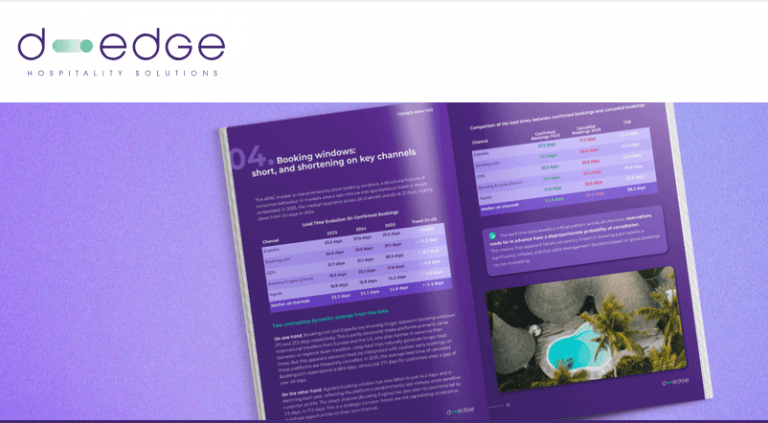
Travelers across Asia-Pacific continue to book relatively close to arrival. The median booking window remained stable at 21 days during 2025. Agoda’s average lead time dropped to just 14.2 days, reflecting its strong position among last-minute, price-sensitive travelers.
Direct bookings also became more last minute, with average lead time falling by 2.5 days to 17.6 days.
The report also identifies a significant gap between confirmed and canceled reservations. On Booking.com, canceled bookings were made an average of 68.6 days before arrival, compared with only 27.1 days for bookings that were ultimately honored.
D-Edge says this difference can distort hotel booking pace reports by creating an inflated picture of future occupancy. Revenue managers should therefore place greater emphasis on confirmed bookings rather than total reservations when forecasting demand.
AI shapes discovery, not bookings
Artificial intelligence has yet to significantly alter market share among distribution channels, according to the report.
Instead, AI is having the greatest impact earlier in the booking journey through conversational search, AI-generated travel recommendations and content discovery, particularly in markets such as Japan, South Korea, Singapore and China.
D-Edge recommends that hotels closely monitor organic search performance and AI-driven search behavior as early indicators of future booking trends.
Looking ahead, the company advises hoteliers to diversify distribution, strengthen direct booking strategies through SEO and conversion optimization, use wholesalers selectively to stabilize occupancy, tighten cancellation policies, and maintain accurate digital content as AI-powered travel search continues to evolve.