Devastating wave of wildfires fueled by extreme heat is sweeping across Europe, forcing more than 300,000 people from their homes and disrupting travel across several popular tourist regions.
Spain and France remain the hardest-hit countries, with emergency crews battling dozens of major fires. Authorities have also reported a tensed situation in Italy with significant blazes in Sardinia and Sicily. Other countries in Europe affected by wildfires include Montenegro, Portugal, Romania and north of Izmir in Turkey.
In the UK, days-long strong fires affect Wales and Scotland. The most dramatic blazes are consuming forests in Blaenavon and Eryri National Park in Wales as well as Cairngorms National Park, north of Aberdeen, Scotland.
The crisis has already claimed at least one life. Spanish authorities confirmed a person died in Manises, near Valencia, after a rapidly spreading wildfire swept through orchards and farmland. Local officials declared two days of mourning.
Madrid region faces critical wildfire threat
The most serious situation in Spain is unfolding west of Madrid, where firefighters are working to stop two massive wildfires from merging.
The blazes, burning in the Madrid region and neighboring Ávila province, have scorched nearly 45,000 hectares. Around 90,000 residents have either evacuated or been ordered to shelter in place.
Spain has mobilized more than 2,700 emergency personnel, over 400 ground vehicles and 21 firefighting aircraft. Reinforcements from Greece, Italy and Portugal have joined operations.
Authorities warn that changing winds and dry vegetation could allow the two fires to connect along a 15-kilometer front, creating an even larger wildfire complex.
Although Madrid-Barajas Airport continues normal operations, smoke and road closures have disrupted travel across western Madrid province and nearby rural tourism areas.
Bordeaux and southwest France endure unprecedented evacuations
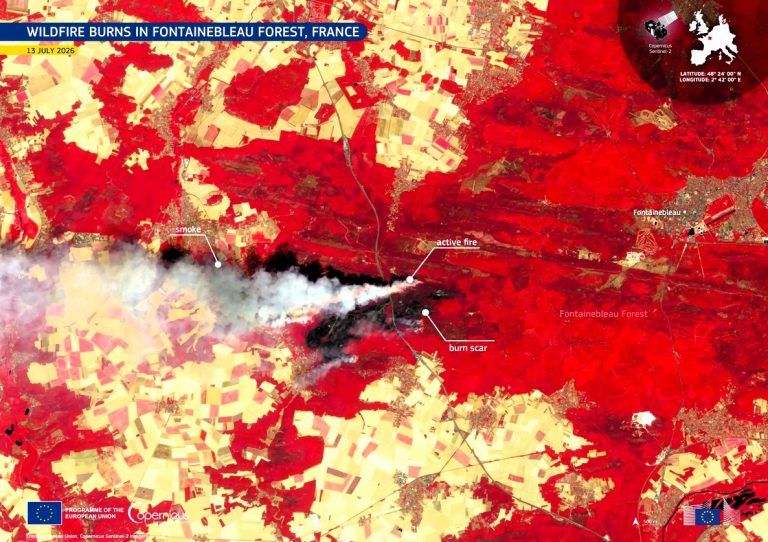
In France, authorities describe the wildfire emergency as one of the country’s worst on record.
Around 30 fires are burning simultaneously across the southwest, particularly in the Gironde and Landes departments surrounding Bordeaux.
More than 200,000 people have been evacuated, making it France’s largest civilian evacuation since World War II, according to officials. Around 7,000 evacuees are being housed in emergency shelters at Bordeaux’s exhibition center.
Additional evacuation orders were issued overnight for several towns, with residents instructed to head toward Bordeaux as flames continued advancing.
Smoke has blanketed Bordeaux itself, turning skies yellow and forcing many residents indoors with windows closed. Authorities are distributing 2.5 million protective face masks to vulnerable residents and emergency workers.
The fires have already burned nearly 100,000 hectares across France. Germany helped its western neighbor by deploying helicopters, aircraft and rescue teams to support firefighting efforts.
Sardinia and Sicily battle another intense fire season
Italy is also experiencing widespread wildfire activity, with Sicily once again among the regions under pressure.
High temperatures, prolonged drought and strong winds have fueled multiple fires across Sicily, threatening rural communities, forests and agricultural land. Firefighters continue working to protect homes and tourist areas as temperatures remain well above seasonal averages. Several wildfires have reached residential areas and farmland in Agrigento province, prompting the evacuation of 100s of inhabitants and extensive firefighting operations.
Sardinia is also facing an active wildfire emergency, with firefighters battling multiple blazes across the island. Authorities have placed much of the island on high alert, with fires threatening forests, farmland and rural communities. Fire crews, supported by water-dropping aircraft, have been deployed to contain several fast-moving fires, while officials have warned residents and visitors to avoid affected areas and follow emergency instructions.
While airports remain open, local authorities have warned visitors to expect possible road closures and reduced visibility in affected areas.
Tourism feels the impact
The fires are affecting both residents and visitors at the height of Europe’s summer travel season.
Smoke has reduced air quality across several destinations, while road closures, evacuations and restricted access to parks, forests and coastal resorts have disrupted holiday plans. Even the Tour de France has been affected by smoke from nearby fires.
Meteorologists warn that climate change is increasing the frequency and intensity of extreme heatwaves, creating conditions for longer and more destructive wildfire seasons across southern Europe.
Emergency authorities continue urging travelers to monitor local advisories, follow evacuation orders where necessary, and remain alert as weather conditions remain volatile across much of the continent. Once more, it proves that climate change is anything but an utopia and a lie…