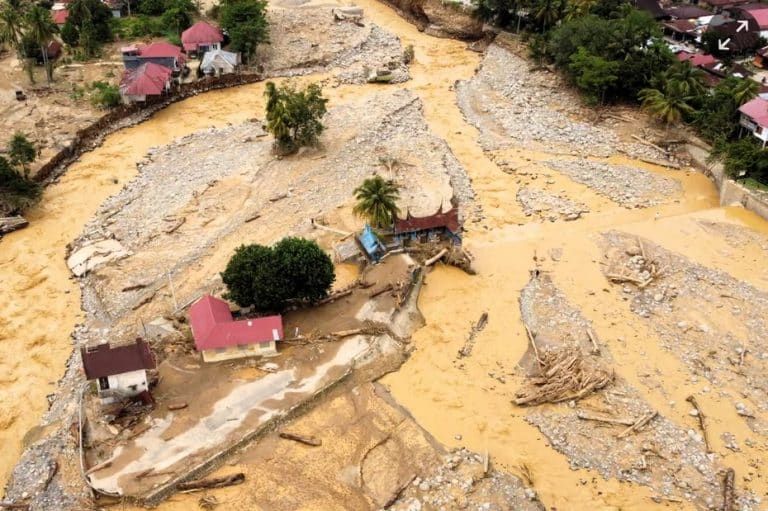
Southeast Asia and Sri Lanka flooding are some of the biggest seen for over a decade. Thailand, Malaysia, Vietnam and Sri Lanka have also reported severe fatalities tied to the same weather cycle.
Thailand’s national toll stands at 170 deaths, Vietnam‘s toll at over 100 deaths while Malaysia has confirmed three fatalities in its northern states.
Nearly 3.8 million people across 10 Thai provinces have been affected, underscoring the regional reach of the disaster. Sri Lanka reported 160 deaths from flooding and mudslides caused by relentless rainfall, adding another layer to the unfolding climate catastrophe. In total, over 1,000 people have died in a week time.
After Thailand, it is now the turn of Sumatra Island in Indonesia to be affected. Flooding and landslides have triggered a humanitarian crisis of staggering scale, with authorities now reporting a rapidly climbing death toll and widespread disruption to critical infrastructure, including air transport routes.
Climate change accelerate catastrophes in Southeast Asia
The National Disaster Management Agency, BNPB, confirmed that over 500 people have died, a sharp increase from earlier figures on Sunday. The surge comes as monsoon rains—supercharged by tropical storms—unleashed some of the worst flooding the region has faced in years, cutting off towns, washing away homes, and leaving entire districts unreachable by land.
Rescue teams have struggled against treacherous conditions, with major highways, bridges, and roads rendered impassable. Power grids are functioning only intermittently, while internet and electricity access remain only partially restored.
North Sumatra, West Sumatra and Aceh provinces are in fact the hardest hit, with nearly 300,000 people displaced. The toll is the deadliest in a natural disaster in Indonesia since a massive 2018 earthquake and subsequent tsunami killed over 2,000 people in Sulawesi.
Air transport is under control with the Ministry of Transport assuring that traffic is operating normally from Sumatra main airports. “In air transport, several airports are reported safe and operating normally. However, road access to some airports has been blocked by floods or landslides, including DR. F.L. Tobing Airport in Sibolga, North Sumatra, and Rembele–Takengon Airport in Aceh,” he noted.
On Monday, flights were operated as usual at Medan Kuala Namu International airport, Banda Aceh, Padang and Palembang.
Pressure is now mounting on Jakarta to declare national disaster status for Sumatra to streamline coordination and accelerate response efforts.
Cyclone Senyar—an exceptionally rare storm that intensified the monsoon system—continues to be cited by meteorologists as a key accelerator in the severity of the flooding. Climate experts warn that warming ocean temperatures and atmospheric instability are making such extreme rainfall events more frequent and more destructive across Southeast Asia.