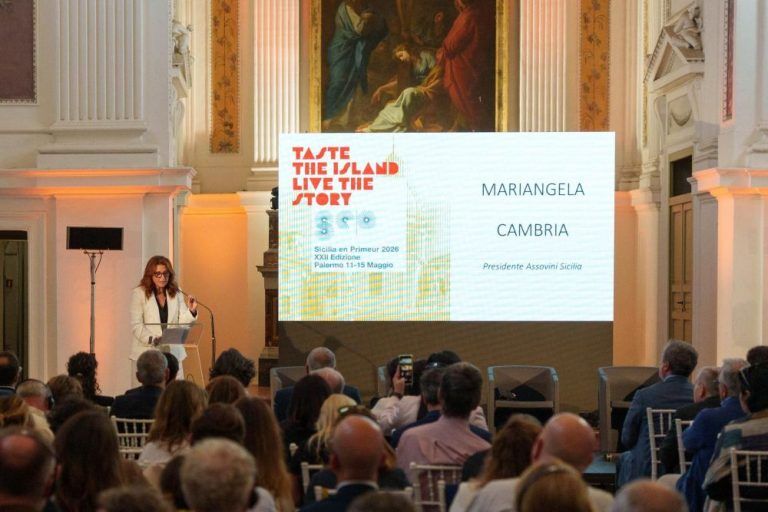
The 22nd edition of Sicilia en Primeur opened in Palermo on May 15 with a strong focus on the future of wine tourism while demonstrating how the sector is growing in economic and cultural importance for Sicily.
The conference titled “Taste the Island. Live the Story” featured 56 wineries showcasing more than 1,000 wine labels.
Mariangela Cambria, president of Assovini Sicilia, said wine tourism in Sicily has evolved far beyond simple tastings. “Talking about wine in Sicily inevitably means talking about a journey,” she said. “Wine tourism today is not only an economic opportunity for wineries, but also a powerful way to tell the story of Sicily through its landscapes, cuisine, art and people.”
The conference explored major themes shaping the sector, including sustainability, digital innovation, hospitality training and changing consumer expectations. Discussions pointed to the emergence of a distinct Sicilian wine tourism model built on authenticity and international appeal.
Research presented by LUMSA University of Palermo showed strong momentum for the industry. According to the survey, 61.4% of Sicilian wineries reported visitor growth in 2025, while nearly 75% said most guests now come from overseas markets, especially Europe and the United States.
Wine tourism is also becoming a growing source of revenue. More than half of surveyed wineries said the segment accounts for about 10% of total business turnover, excluding direct wine sales. Tastings and guided tours are increasingly viewed as strategic marketing tools.
Sustainability emerged as another major strength. Nearly 87% of wineries surveyed generate renewable energy, 88% have eliminated single-use plastics in hospitality operations and about 70% use lighter-weight wine bottles.
The study also found wineries are rapidly expanding their visitor offerings, with tasting rooms, wine shops and guided experiences now common across the region. Almost six in 10 wineries implement or will implement new premium tourism experiences for 2026.
Digital communication and AI
Digital adoption is improving as well. While websites, e-commerce platforms and mailing lists are now standard, more advanced tools remain limited. Only 20% of wineries currently operate wine clubs, while just over 30% are using artificial intelligence, mainly for marketing and communications.
The research offers an important roadmap for the sector’s future development, highlighting what the wine tourism industry needs to improve in the years to come to reach full competitive maturity.
The conference also examined wine’s relationship with younger travelers and consumers. Research presented by Vincenzo Russo of IULM University found that 51% of Italians aged 20 to 24 now drink wine — the highest figure ever recorded for the age group. Winery visits and immersive experiences were identified as key drivers behind that growing interest.
“Young people are not rejecting wine,” Russo said. “They are looking for authentic experiences, cultural connections and meaningful storytelling.”
Artificial intelligence was another central topic. Edoardo Colombo, president of Turismi.AI, said AI could help Sicily become a leading smart wine tourism destination by offering more personalized and predictive visitor experiences.
The event concluded with a focus on training and hospitality as critical tools for boosting direct sales and strengthening Sicily’s tourism economy.
“Sicily already has everything needed to become one of the world’s leading wine tourism destinations — authenticity, biodiversity, culture and hospitality,” Cambria concluded. “The challenge now is creating a shared vision that turns this heritage into sustainable growth for the entire island.”