According to the latest ICCA Globewatch Business Analytics 2025 Report, South Africa secured the top position on the African continent with 115 international association meetings, reaffirming the country’s competitiveness in the global MICE sector. Cape Town also retained its position as Africa’s leading city for international association meetings.
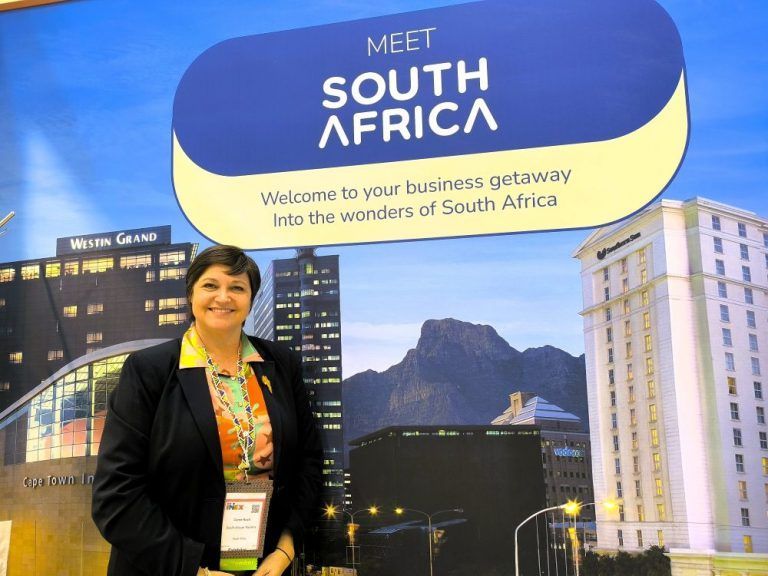
South Africa’s participation at IMEX Frankfurt 2026 provided a strategic platform to showcase the country’s world-class capability to host business events of every scale.
Chief Convention Bureau Officer of South Africa National Convention Bureau, Corne Koch, highlighted in an exclusive interview to TravelMole how South Africa’s ICCA ranking represents a strong endorsement of the country’s long-term investment in business events infrastructure. She also outlined the bureau’s evolving strategy, growth markets, and plans to expand the country’s MICE footprint beyond its traditional gateway cities.
What is South Africa’s current strategy to promote the destination internationally for meetings and events?
Corne Koch – We are revisiting our overall strategy, not necessarily because of geopolitics, but because we want to reposition South Africa more strongly in the global market. One important aspect is aligning more closely with South Africa’s key economic sectors such as engineering, mining, science and innovation. We want to attract conferences that are relevant to these industries.
At the same time, we are working closely with local communities and regional partners to move conferences beyond the traditional city centers. International visitors already know Cape Town and Johannesburg, but there are many other areas with excellent conference facilities and unique experiences.
Our strategy combines international marketing with direct engagement through trade shows, meetings and partnerships with event organizers and corporate buyers.
Which international markets are currently the strongest for South Africa’s MICE industry?
Corne Koch – Traditionally, our core European markets remain Germany, France, the UK and the Netherlands. We are also seeing opportunities from South America.
At the same time, we are focusing strongly on growth markets such as China, India and Southeast Asia, particularly Indonesia and the Philippines. Connectivity is essential for a long-haul destination like South Africa, so new air links are very important for us.
We recently welcomed a new direct connection between Perth and Johannesburg, which opens further opportunities with the Australian market.
Is Australia turning into an important source market for South Africa?
Corne Koch – Absolutely. While Australia and South Africa may share similarities in terms of landscapes and wildlife, the experiences are still very different. South Africa offers enormous diversity within shorter travel distances than in Australia. Visitors can experience Cape Town, Johannesburg, the bush, mountains, wine regions and coastline all within a relatively compact area. Every few hundred kilometers the scenery changes completely.
The culture and hospitality are also a major attraction. Visitors can combine urban experiences, wildlife and luxury incentives very easily in one trip.
Safety perceptions remain a concern for international MICE planners and travelers. How does South Africa address this issue ?
Corne Koch – We are very aware of those perceptions and work hard to provide visitors with accurate information. Like many major global cities, travelers simply need to be street smart and informed about where to go.
The tourism industry understands the importance of visitor safety and works closely with local authorities and hospitality partners. In Cape Town, for example, there are visible safety monitors and hospitality ambassadors throughout key tourism areas.
Many visitors arrive expecting major problems and are often surprised by how welcoming and comfortable the experience is. Tourism is extremely important for South Africa’s economy, so the industry takes visitor experiences very seriously.
Q: Which destinations outside the major cities are you currently promoting for meetings and incentives?
Corne Koch – Around Johannesburg and the Gauteng region there are beautiful mountain areas and nature-based venues such as the Cradle of Humankind, offering smaller conference facilities ideal for groups of 200 to 500 delegates. I also think of Sun City and Pilanesberg National Park, 200 km north of Johannesburg with outstanding facilities for groups.
Outside Durban, the Drakensberg mountain region offers spectacular scenery for conferences and incentives. In the Western Cape, destinations such as Stellenbosch, Franschhoek and the surrounding wine regions continue to grow strongly for luxury incentive travel and smaller corporate events.
We also have programs encouraging meeting planners to consider destinations beyond the traditional urban centers, particularly for domestic and regional events.
Q: What role does Pretoria play in South Africa’s meetings industry?
Corne Koch – Pretoria, which forms part of the wider Tshwane metropolitan area, is an important government and diplomatic hub. Many government meetings, NGO events and African regional conferences are hosted there.
The city is well connected to Johannesburg and the airport through the Gautrain rail network. It also offers easy access to nearby game reserves where visitors can experience wildlife very close to the city.
Are there new tourism or convention infrastructure projects underway?
Corne Koch – Cape Town International Convention Centre has already expanded with CTICC 2, and there are ongoing discussions around future investment and expansion opportunities.
Century City Conference Centre in Cape Town has also grown rapidly and recently expanded further due to strong demand from the corporate meetings market.
Elsewhere, private sector investment continues to increase. Club Med is opening a new resort near Durban, which will also support incentive travel and corporate groups.
We are seeing strong investor confidence in South Africa’s business events sector because of the long-term growth potential.