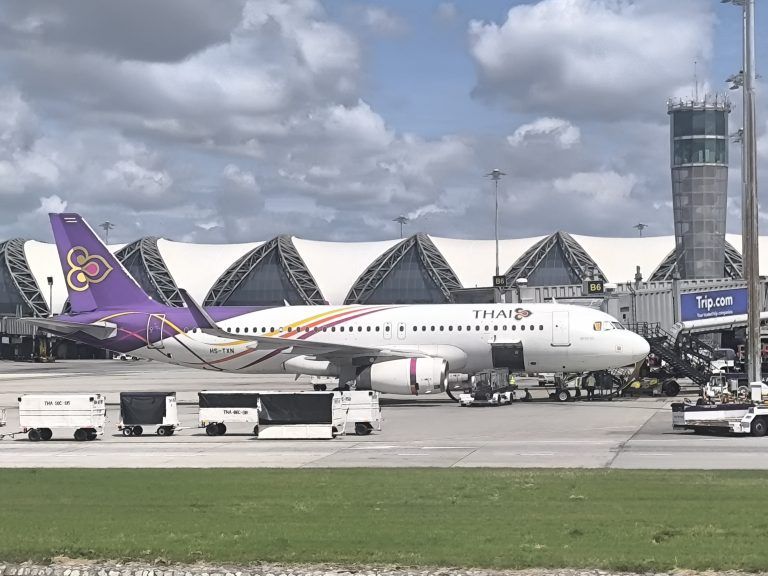
Thai Airways International prepares to expand strongly for the coming winter season 2025/2026. The focus is clearly on China, despite the slump in tourist arrivals from that country.
The airline is however looking at China rather as a way to boost connectivity than attracting point-to-point traffic. According to Thai Airways International Chief executive Chai Eamsiri, the airline’s strategy is to reduce reliance on single markets.
It targets at sustaining passenger numbers through the low season, improving slot use, and spreading risk. “We aim to strengthen our position as a regional hub, connecting Asia and beyond,” told Eamsiri to the newspaper Bangkok Post.
China focus
The carrier is betting heavily on China. Thai currently serves Shanghai, Beijing, Chengdu, Kunming, and Guangzhou with 42 weekly flights. Starting with the 2025–2026 winter schedule, flights to Beijing and Guangzhou will double from seven to 14 per week. The carrier will further reinstate flights to Xiamen, Chongqing, and Changsha. While Wuhan and Shenzhen will be added to the network.
The expansion is expected to double flight capacity in China and significantly lift revenue. Thai expects not only to serve Chinese passengers but also to attract travelers from Europe and Australia transiting through Bangkok. Current load factors average 70% during low season and 80% in peak months.
Thai is also eyeing new services to Gaya, India. It also wants to enhance its domestic network.
Eamsiri noted that passenger booking patterns are shifting. Asian travelers are now booking three to four months before departure, down from six months, often waiting for sales. European travelers continue to book about six months ahead.
More aircraft to arrive next year
The airline’s expansion is sustained by the delivery of medium-haul aircraft. Thai now operates 78 planes, including 58 wide-bodies. One Airbus A321neo is set to join the fleet this month, with another A321neo and a Boeing 787-9 arriving before year’s end. These aircraft will be consequently deployed on China and India routes.
Deliveries of 15 more A321neos will begin next year. To bridge gaps, Thai Airways International plans also to lease 8 to 10 wide-bodies until delivery of its own ordered aircraft.
Cabin refurbishments are also planned across the A320, Boeing 777-300ER, and Airbus A350 fleets to unify the in-flight product.
Looking further ahead, Thai Airways International has firm orders for 45 Boeing 787 Dreamliners. The first nine will arrive in 2028. By 2033, the airline aims to nearly double its fleet to 150 aircraft. This will include among others 64 Dreamliners and 52 A321neos.