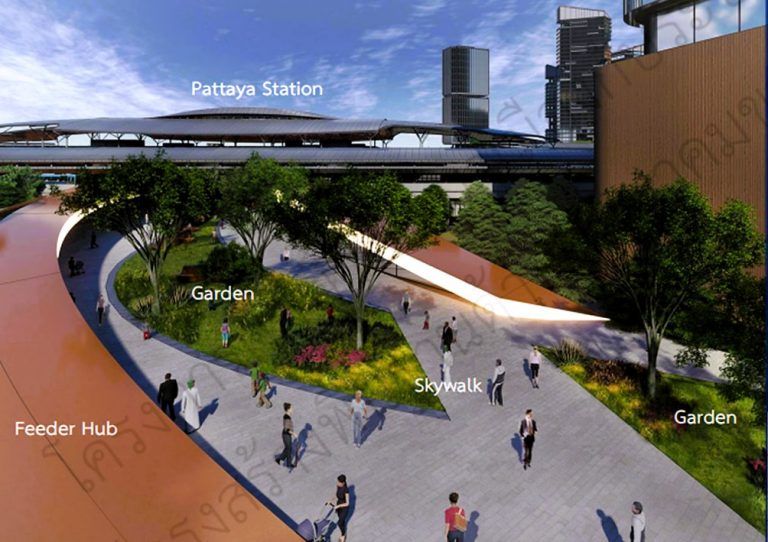
For nearly a decade, Thailand has been selling travelers an enticing vision: step off an international flight at Don Mueang or Suvarnabhumi Airport and board a sleek high-speed train bound for Pattaya in little more than an hour. It sounded like the kind of seamless airport-to-beach connection that modern travelers love—and one that would put Thailand alongside Asia’s rail heavyweights.
However, like many glitzy projects launched by Thailand successive governments, the project has become a masterclass in how not to build an infrastructure.
The 220-kilometer high-speed line was conceived as a flagship component of the Eastern Economic Corridor (EEC), Thailand’s ambitious development strategy aimed at transforming the country’s eastern seaboard into a regional business and technology hub.
The line would link Don Mueang Airport, Suvarnabhumi Airport, the infamous seaside resort of Pattaya to finish at U-Tapao Airport, while incorporating the existing Airport Rail Link. Designed for trains operating at up to 250 km/h, the service promised to slash journey times, reduce highway congestion and create Thailand’s first true high-speed passenger rail service.
On paper, it ticked every box. Bangkok’s two international airports handled in 2025 over 95 millions of passengers. While Pattaya continues to rank among Thailand’s busiest leisure destinations with over 10 million international visitors. Connecting them with fast, reliable rail would benefit tourists, business travelers and local commuters alike.
Never-ending construction conditions
Construction was awarded in 2019 to the Asia Era One consortium, led by Charoen Pokphand (CP Group), under a public-private partnership valued at more than $7 billion.
Then reality arrived. Land acquisition proved painfully slow. The relocation of utilities became bogged down. The Covid-19 pandemic disrupted financing and passenger forecasts. For a project intended to symbolize Thailand’s infrastructure ambitions, progress has been remarkably difficult to spot.
The Bangkok Post reported comments from State Rail company SRT governor Anan Phonimdaeng on July 1, 2026. He estimates that “lenders have lost confidence in the project’s commercial viability following the Covid-19 pandemic and subsequent economic downturn, which significantly reduced passenger forecasts. As a result, financial institutions have become reluctant to provide funding, making it difficult for the concessionaire to proceed.”
His comment is rather surprising due to the existing high volume of passengers. Even with only 10% of passengers recorded at airports and visitors in Pattaya, the train line could easily attract over 10 million travelers a year -if not more…
Cost inflation followed, and negotiations over revised contract terms dragged on for years. Government officials and the private consortium remain at odds over financial guarantees, investment conditions and amendments to the concession agreement. Without a finalized revised contract, major construction remains largely stalled despite years having passed since the original groundbreaking.
Travelers visiting Pattaya today are still far more likely to find themselves sitting in a bus in the midst of Bangkok traffic jam than gliding through the countryside aboard a bullet train. There is alternatively a daily train (two on week-ends) making its way laboriously from Bangkok main train station to Pattaya in a 3-hour trip…
Whether this line eventually opens—or simply earns a place in the growing museum of “coming soon” infrastructure projects—remains to be seen. For now, the country’s fastest journey is still the speed at which new completion dates disappear from the timetable.