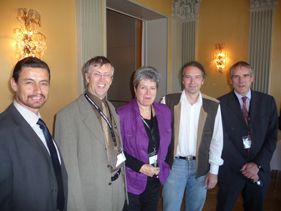
Members of the Ecotrans Network on Sustainable Tourism Development attending Gothenburg making a strong contribution to Gothenburg Symposium(left to right Gordon Sillence, DestiNet Executive and symposium content coordinator; Herbert Hamele, Ecotrans President; Lisa Davies, European Travel Commission; Christian Baumgartner, Friends of Nature International ; Richard Denman, the Tourism Company UK.)
When the European Travel Commission (ETC) embarked on the process of informing its 39 national member state tourism organizations about the issue of climate change, it quickly entered into the area of sustainable tourism development. That is because sustainable tourism is the sector`s positive response to climate change. The ETCs director Rob Franklin, put the correct message across that climate change is a driver of sustainable development, and the tourism sector needs to pick up the baton and develop greener, socially responsible tourism in order to secure both current and future market operations.
To that end (destinet.ew.eea.europa.eu ) to inform national organizations of global and European policy lines such as the UN Davos Tourism and Climate Change Process and the European Commission`s sustainable consumption and production programme. As a Portal DestiNet links different websites together so that visitors can find their way through the climate change and tourism internet information jungle. DestiNet is a state of the art knowledge networking tool that has taken up to 500,000 euros and five years of technical development, finally launched in Gothenburg to support UN and EU sustainable tourism development.
The DestiNet Climate Change and Sustainable Tourism Learning Area points visitors to key global and European websites, using a multi-stakeholder approach that involves considering points of view of governments, businesses and civil society organizations. It then allows stakeholders to upload their own content, and develop dialogue and information exchange between organizations. Under the executive management of the Ecotrans Network on Sustainable Tourism Development, It has become the most comprehensive best practice database, maintaining the DestiNet Atlas of Excellence, collating over 250 examples of sustainable tourism products and services that have all won a range of quality awards.
Alongside the vast information base it leads to, the Portal has developed the world`s first and biggest global sustainable tourism market place, allowing stakeholders with socially responsible, green tourism products and services to upload and display them in a unique mapped-based directory system. As an example, the Austrian environment ministry has already uploaded over 200 certified sustainable products and services available in Austria, and all global certification systems are also listed.
The Learning Area is still in its embryonic form, and needs stakeholders to understand its function in relation to their own knowledge development programmes and website communication strategies. Anyone who is developing a certified tourism product or service should be interested in this opportunity join in a permanent sustainable tourism knowledge networking system, and to put local/regional offers into a global marketplace. As a follow up to Gothenburg and in line with Copenhagen discussions, the Portal directors are looking for both national and regional initiatives to come forward and integrate their good practice knowledge, products and services in the Portal to start piecing together the tourism sectors` contribution to global green economy mosaic.
The DestiNet Atlas of Excellence provides a collation of award winning sustainable tourism best practice examples destinet.ew.eea.europa.eu/whos-who