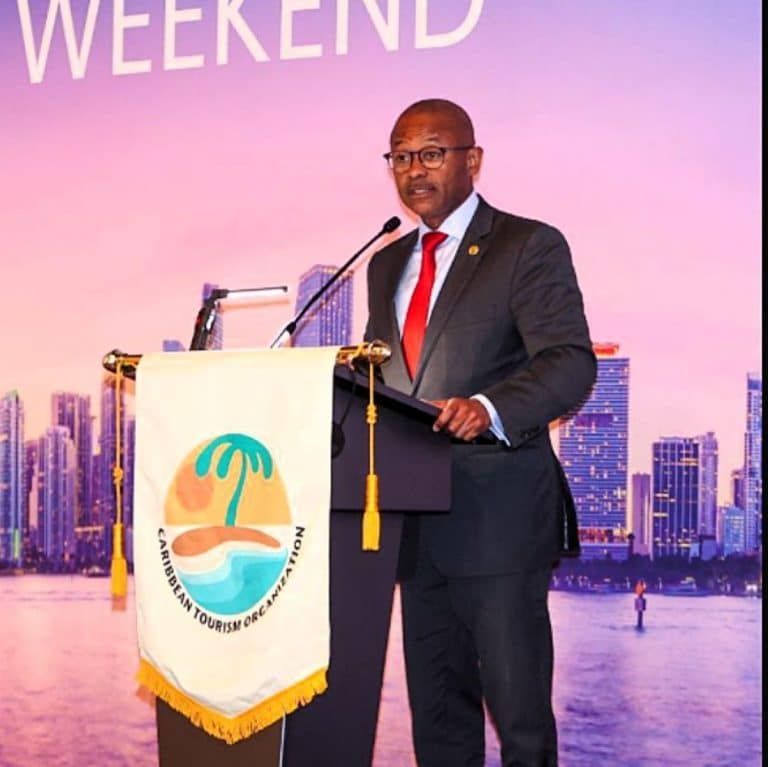
In the wake of Hurricane Melissa, Caribbean tourism leaders, government officials and private-sector executives gathered in Miami this late December to reaffirm tourism’s central role in recovery, resilience and long-term growth across the region. The discussions unfolded during the Caribbean Tourism Organization’s (CTO) second annual Caribbean Weekend, including a high-level “Iconic Summit” aboard Royal Caribbean’s Icon of the Seas.
The summit placed the cruise industry at the center of post-storm recovery efforts. Royal Caribbean International President and CEO Michael Bayley outlining the company’s rapid response following the October hurricane. Bayley said Royal Caribbean delivered more than 100 pallets of emergency supplies—ranging from generators and food to water and medical essentials—to Jamaica’s port of Falmouth, while coordinating with partners to support distribution in the hardest-hit communities and provide meals to displaced residents.
In conversation with CTO Secretary-General and CEO Dona Regis-Prosper, Bayley emphasized that the company views itself as part of the Caribbean fabric. “Over the years, we’ve always tried to support Caribbean communities,” he said. “Especially in times of crisis, we answer the phone and do our best to help.”
CTO Chairman Ian Gooding-Edghill, Barbados’ Minister of Tourism and International Transport, stressed that stronger collaboration between governments and the private sector is essential. “The future of Caribbean tourism depends on our ability to reimagine together—to innovate, collaborate and believe in the boundless potential of our region,” he said, highlighting the need for data-driven policy, improved connectivity and community-centered growth.
Bayley also called for comprehensive destination “master planning” to ensure sustainable tourism development, while pointing to opportunities for cruise lines and governments to expand employment pathways for Caribbean youth. He cited ongoing discussions with labor ministers to address long-standing workforce barriers and highlighted Royal Caribbean Group’s investments in environmental technologies, shore power and resilient port infrastructure.
A new climate reality
That message of resilience carried through to CTO’s Holiday Dinner and Fundraiser, where Jamaica’s Minister of Tourism, Edmund Bartlett, delivered a stark assessment of Hurricane Melissa’s impact. Preliminary estimates place damage in Jamaica alone at between 28 and 32 percent of GDP, with some international assessments exceeding US$10 billion.
“Once again, the recovery of tourism will be the spearhead for the recovery of the nation,” Bartlett said, noting that tourism supports more than 300,000 jobs in Jamaica and accounts for over 30 percent of GDP in several Caribbean economies. He warned that increasingly intense storms signal a new climate reality, urging coordinated action through initiatives such as the Global Tourism Resilience and Crisis Management Centre.
Haiti’s Deputy Chief of Staff for Tourism, Innocent Junior Richard, echoed that resolve, telling attendees, “We’re still alive, we’re still fighting,” as he thanked the region for standing with Haiti and Jamaica.
Caribbean leaders agreed on one central truth: tourism remains the region’s economic engine—and resilience must be built up to let the sector bringing prosperity.